
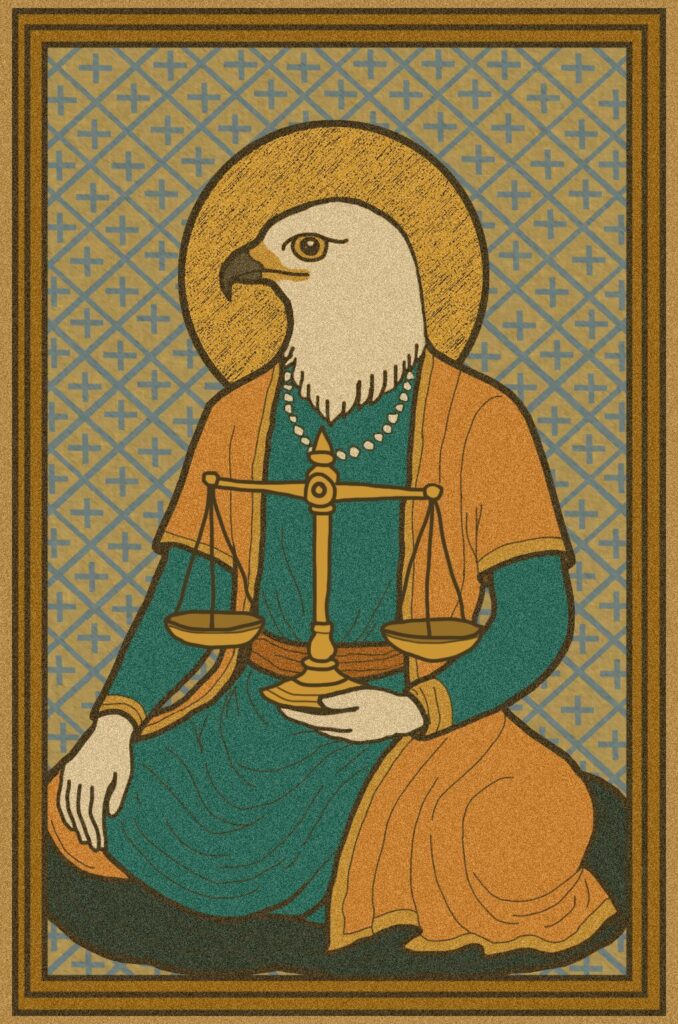
So here’s something I love about Zoroastrianism, the ancient Persian religion that inspired the Emari Chronicles. It’s that their version of the afterlife doesn’t have a kindly god sitting in judgment, deciding whether you were good enough based on vibes and intent. You cross a bridge called the Chinvat, and your deeds get weighed. On scales. Like grain at a market. No partial credit, no explaining yourself, no mercy gap for context. The scales say what the scales say.
The figure who runs those scales is Rashnu. And y’all, the moment I read about him, I knew he wasn’t going to stay a minor angel in my world.
In the tradition that inspired Emari, Rashnu is one of many divine figures, important but not primary. I changed that. I made him the head of the pantheon, the balancer, the one everything else orbits. The reason is baked right into what he is. A being whose entire existence is the maintenance of equilibrium, who sees every path and weighs every deed, who doesn’t have favorites or make exceptions. That’s exactly the kind of being you want at the top of your cosmology when your story is fundamentally about what it costs to do the right thing.
It’s also the kind of being who would use a child as his voice and see absolutely nothing wrong with it.
That child is Pari, and she’s one of my favorite characters in the whole series. She shows up in the first chapter of The Hand of Mashyana and grabs Farah by the hand. Farah is a trained soldier and a senior member of the Mashyana’s household. Pari is maybe eight years old, and she is completely unconcerned with that power difference.
“I am Pari. Rashnu wants me to help you not die quite so soon.”
She has been watching Farah for a while, actually. Rashnu has been showing her the paths Farah can take, the ones that end soon and the ones that don’t, and now she’s here to redirect things. When Farah pushes back and asks what could possibly be lost if she doesn’t follow a child through the city streets, Pari waves her free hand in exasperation.
“All the things.”
That’s what happens when the being doing the sending doesn’t weigh things by how they feel, only by what the scales require. Pari is the right instrument for the path. To Rashnu, that’s sufficient.
I also gave him the head of a white hawk, golden-eyed, with wings that fold behind him like something out of an illuminated manuscript. And I did that deliberately, because early in Book 1, that hawk keeps appearing. It shows up wounded on a windowsill while Farah and Yasher are mid-argument, its golden eyes flickering between them before it bursts off the sill and disappears into the sky.
“A harbinger,” Farah says, almost to herself.
“Looked more like an angry bird to me,” says Yasher.
He’s not entirely wrong. It is an angry bird. It’s also been leading them toward the Chinvat Bridge the whole time, and they don’t know that yet.
When Farah finally crosses the bridge inside the Forgotten Temple and the air shimmers ahead of her, she sees him for the first time.
“His form towered, nearly twelve feet tall, with the powerful body of a man, draped in robes of pristine white that shimmered as if woven from stardust. His face was that of a great white hawk, fierce yet wise, golden eyes gleaming with a depth that seemed to reach through time itself.”
“Farah,” the figure speaks, his voice soft yet resonant, like the hum of a distant drum. “You have crossed the threshold.”
He gives her a choice on that bridge. He tells her what each option will cost. He doesn’t tell her what to choose. That’s not what the scales are for.
If you want to know what she picks, the book is waiting.