
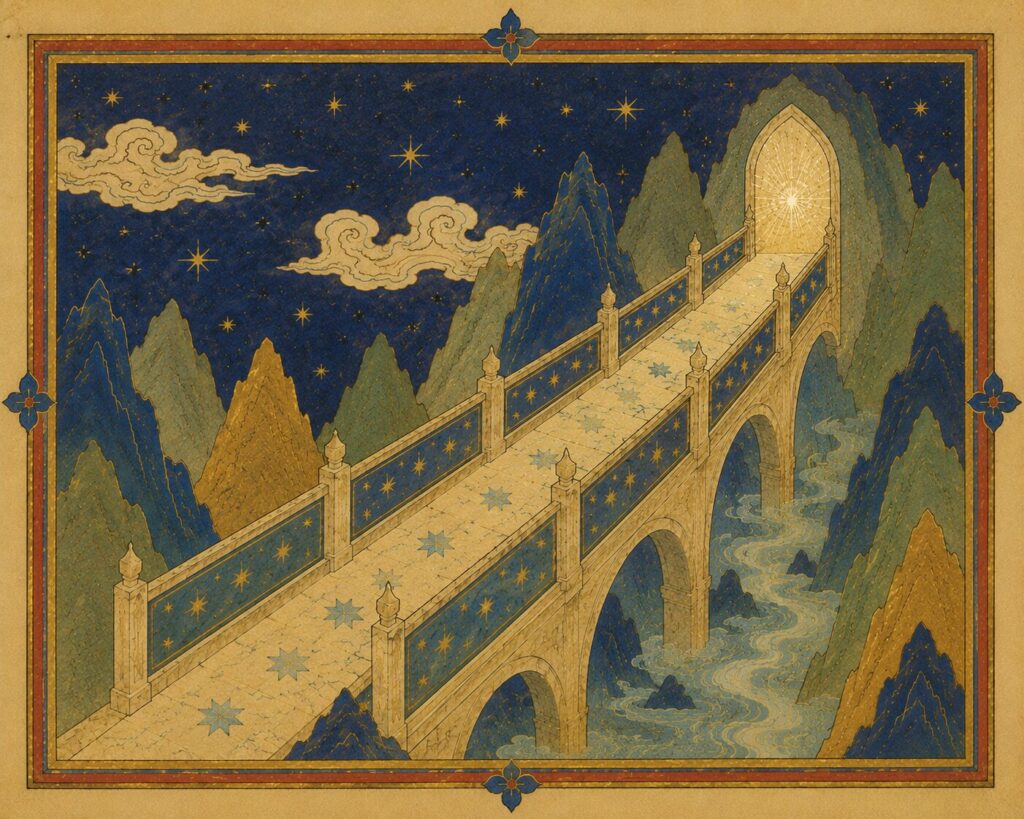
My history degree is responsible for a lot of things in the Emari world that I didn’t plan, and the Chinvat Bridge is probably the best example of that. It showed up in an early outline as a cultural reference, the kind of thing people in Emari invoke when they talk about death and judgment, the afterlife infrastructure that tells you what kind of civilization you’re dealing with. Mythology, comfortable at a distance.
And then I kept pulling on it and it didn’t want to stay comfortable.
In the Zoroastrian tradition that inspired the Emari Chronicles, the Chinvat Bridge is where every soul goes after death. The righteous find it wide and easy. The wicked find it as narrow as a razor’s edge. Rashnu stands on it with his scales and there is no appealing the outcome. It’s not a metaphor. It’s cosmology, the literal architecture of what happens when you die, and the more I sat with it the more I kept thinking about what it would mean if it was also a room, something you could walk into while you were still alive and put your hands on the railing.
That’s how the Forgotten Temple happened. The Chinvat Bridge in the Emari Chronicles is a physical place, hidden inside the Forgotten Temple, a ruin so ancient it predates any living history, buried deep in a cave network at the base of the mountains, with no maps to mark it and no records to name it. Most people in Emari treat it the way Yasher does when he first sees it, as myth, as the kind of thing that is true without being real.
“The bridge souls cross to meet Rashnu,” he murmured, repeating her earlier words as though trying to anchor them in reality. “I thought it was just a story.” Farah turned to him, her voice trembling. “It’s not just a story. This is… this is where the dead are judged. This bridge… it’s not meant for the living.”
It is not meant for the living. That was the constraint I gave myself when I built it, and it turned out to have consequences I didn’t fully anticipate, because if you make sacred ground into a physical place you have to think about what happens when living people stand on something that wasn’t designed for them. The bridge falls apart around Farah and Yasher the entire time they’re on it — the stone pulses with its own inner light, the water below glows bluish-white, the carvings shift under the torchlight. It’s gorgeous and it is also actively collapsing, sections crumbling into the dark while they’re still crossing it, a gap appearing that they have to jump, Yasher getting hurt badly enough that Farah has to leave him and cross the rest of it alone.
The Chinvat Bridge stretched ahead, a translucent path of light suspended above an endless chasm that seemed to swallow sound and thought alike. Behind her, the edges of the mortal world faded into mist, separating her from everything familiar.
What she finds at the other end is Rashnu, and a choice he gives her, and a truth about what she was actually sent into the Forgotten Temple to retrieve. I’ll let Book 1 tell you that part.
What I will tell you is what’s on the other side of the bridge when you’ve been properly judged. The House of Song is where the righteous go, peace and rest and reunion with the divine, and the House of Lies is the other thing, reckoning in proportion to the harm you caused in life. In Emari’s burial rite, the Leaving, that ritual of water and cedar and burning saffron, exists to prepare someone for exactly this crossing. Death in Emari isn’t the end of the story. It’s the appointment you’ve been preparing for your whole life.
Farah knows all of this when she crosses the bridge alive, knows she’s somewhere she has no business being while her heart is still beating. She goes anyway.
“I walked the Chinvat Bridge. The godly one.”
She says it to Yasher after, like she’s still not sure he’ll believe her, like she’s still not sure she believes it herself.
What Rashnu told her on the other side of that bridge is what Book 1 is built around. If you want to know what it cost her to cross it, the book is waiting.