
There’s a design problem at the heart of every fantasy world that has gods in it. The moment the divine shows up and starts answering questions, your characters stop having to wrestle with faith. They just have to follow instructions. That’s not a story I wanted to write.
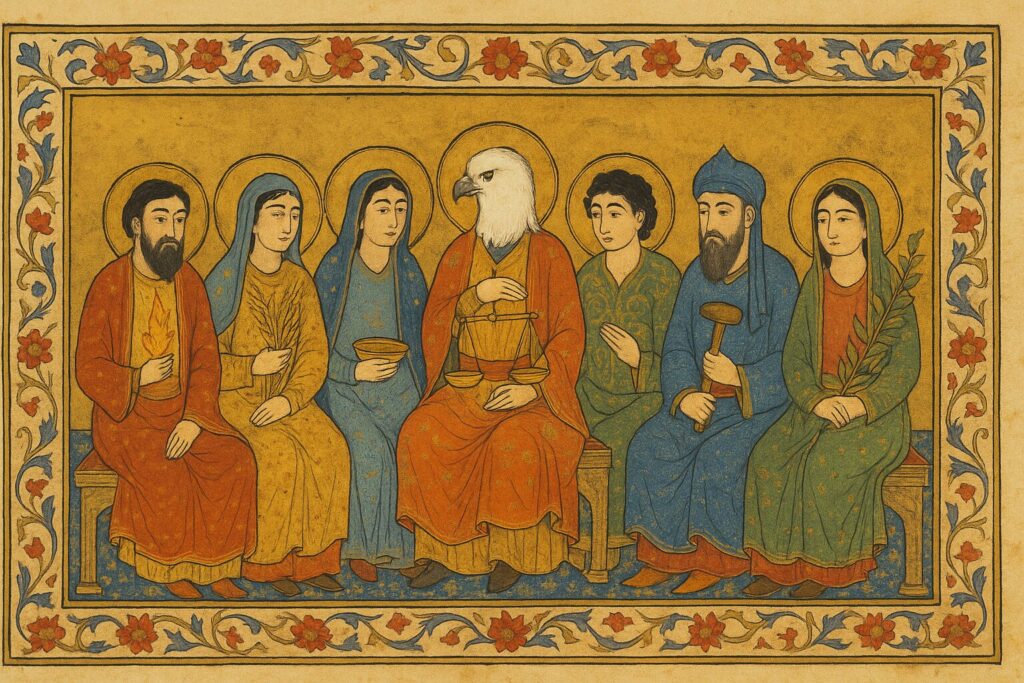
In the ancient Persian mythology that inspired the Emari Chronicles, yazatas are divine helpers, beneficent beings who move through the world alongside humanity, present and working and close. The outer walls of Banima are covered in them. Immense, sprawling murals depicting entire legends, scenes of gods and mortals intertwined.
Scenes of gods and mortals intertwined, the Yazatas bestowing blessings upon the people, and the Amesha Spentas guiding them through trials.
The murals name two groups of gods. Yazatas bestow blessings. Amesha Spentas guide through trials. Both are gods. Same status, different jobs. In the books, I don’t always distinguish which god belongs to which group, and neither does Emari. After centuries of absence, precise theology becomes imprecise memory. People say “by the Seven” and mean all of them. The court invokes the Unnamed Gods and their Yazatas in a single breath without sorting roles. Doctrine blurs when no one is present to correct it. For this post, when I say Yazatas, I mean all of them.
There are seven of them, which is where the oath comes from. By the Seven. You’ll hear it across both books, and this is the first place I’m putting all seven names together. The Seven were created by the Unnamed Gods, who built the world for them and then went away. When, or why, nobody knows. Their stories didn’t survive long enough to be recorded. What remained was the world they made and the Seven they made to tend it, with Rashnu as their head and firstborn.
Rashnu you’ve already met, standing watch over the Chinvat Bridge. His domain is justice, fate, and the weighing of souls. Ameretat governs immortality and the sacred cycles of growing things. Vohun holds air, thought, and speech. Havayat is water, healing, and purity. Ashvash is fire, truth, and righteousness. Aramati holds earth, piety, and endurance. Khshathri is the forge, the metal, the protection that comes from knowing how to build something that lasts.
Seven domains. Seven jobs the world still needs done, with only the Talents, the Voices, and the relics holding what was left behind.
The relics deserve their own mention. The Shard of Ameretat and the Eye of Rashnu carry the names of the gods directly. The Veil of Takhsha is different, though. Takhsha wasn’t a god, she was a worshipper of Vohun, ancient enough that her story is gone, but what she left behind isn’t. The Veil bears her name, and Vohun’s domain moves through it. That distinction matters. Some of these objects came straight from the divine. Some passed through human hands first, named for people whose devotion ran deep enough to leave a mark on the world long after they were gone. They surface across both books, and the fact that someone has been collecting them is one of the things The Hand of Mashyana is built around. If the gods are gone but the relics remain, then the power hasn’t vanished. It just became portable. Findable. Stealable.
The court still invokes the gods formally, too.
“May the Unnamed Gods and their Yazatas show their Grace within My Hand.”
Behnaz says those words at Farah’s investiture, a blessing so old and so frequently spoken that it’s started to feel like furniture. But furniture had to be built. The Unnamed Gods are in that line. Nobody in Emari could tell you much more about them than that — they’re in the invocation, and that’s essentially where the knowledge ends. Someone put them there and kept them there long enough that it became ceremony. What they were, what they wanted, what they looked like — no record. Just the name, and the habit of saying it.
Farah grew up beneath a different kind of record. The stained glass rotunda at the heart of the Citadel is the creation story. It is simply where the story begins, as far as anyone in Emari is concerned. The Seven are already here. The world is already made. Nobody is missing the chapter before it because nobody knows there was one. She has memorized every panel since childhood. The gods standing tall and radiant, hands outstretched, blessing the land. Then the seven standing apart, their luminous forms marred by fractures spreading through the glass like cracks in a mirror. The rotunda doesn’t explain those fractures. It just shows them. Seven gods who once stood together and then didn’t, and the muralists knew better than to name what happened. Then the departure. An empty sky. The Talents they had bestowed lingering like echoes in those they had touched.
She has looked at Rashnu in that glass her entire life. The Hand of Mashyana takes her to the other end of the Chinvat Bridge, which is where she finds out what the difference is between a god in a story and a god who is watching you cross toward him.
Presence. Fracture. Departure. Echo. That sequence is the architecture the entire series runs on. The official theological explanation, the one Farah was raised with, is practical in a way I find genuinely interesting. The ancient texts say that if the gods died, the world would die with them. So they departed this plane, pulling back to let the world survive without them, and what they left behind were Talents, their power living on in human bodies. And the relics. And the rituals. And the murals and stained glass showing what the world looked like before.
What I didn’t want to write was a simple vanishing. The Yazatas didn’t disappear. They withdrew. There’s a difference, and it matters for how the story works. Part of the difference is the Voices.
Pari is the Voice of Rashnu. Not a metaphor. A role. She sees what she sees because he shows her. She speaks about death and judgment with an authority that doesn’t come from theology. It comes from him. Jeta is the Voice of Ameretat, which is why she cannot stay dead. Ameretat’s domain is life and growth and what endures. Her Voice doesn’t stop until Ameretat decides she’s done.
“I am a tool. A vessel. Ameretat’s Hands in the world, for as long as she deems me useful, which has so far been… let’s see… around 460 years, give or take. It has… benefits. And a rather irritating lack of permanence when it comes to dying.”
That’s Jeta, in The Veil of Takhsha, telling Yasher what four hundred and sixty years of that role actually costs. In the same book she speaks about Pari, and what that carries is specific fury at Rashnu for choosing a child as his Voice. Jeta has been living the role for nearly five centuries. She knows what it demands. He gave Pari the strength for it, she says, but not the stamina. What Pari does with what she’s been given is her own. Jeta is careful to keep that separate from her anger at Rashnu.
The gods aren’t walking the roads. But Rashnu still holds the bridge. Ameretat still acts through Jeta. The Voices are the active connection the gods maintained with the world when they withdrew from it, and they run both directions.
A world where the gods withdrew is a world where everyone is living in the shape something larger left behind, trying to decide what to do with it. The shape they left is everywhere. The relics. The Talents. The Voices. The Leaving, the burial rite of water and cedar and burning saffron that prepares the dead for the crossing Rashnu still holds at the end of the bridge. The faith didn’t collapse when the gods departed. It grew more intricate, filling the silence with ritual.
But faith is one answer. Behnaz had another. The gods left us to rot, left this kingdom to crumble. Her reading is grief and fury made into theology, and whether she’s wrong about it is a question the series is still answering.
Mazdavir is what happens when her answer gets to run a kingdom. The rumors about what Mazdavir actually is, whether something the gods made that went wrong or something connected to the gods in ways the books don’t fully name, make Behnaz’s fury considerably more complicated than it looks on the surface.
And then there’s Farah, who has actually stood in front of one of them while her heart was still beating, and doesn’t fit cleanly into either category anymore.
That’s the story. The Hand of Mashyana and The Veil of Takhsha are waiting if you want to find out what it costs her to know what she knows.