
I’ve said for years that it’s the story in a song that makes me love it. Not the production, not even the melody first. The lyrics. I’m a lyrics-first listener. Music follows.
My kid Liz introduced me to The Amazing Devil in 2021 after discovering them through The Witcher. Joey Batey, who plays Jaskier, is one half of the duo. I added them to my regular playlists almost immediately because the stories they tell within their songs grabbed me in a way I hadn’t expected. There’s a theatrical quality to their folk that earns its emotion. Nothing feels cheap. And I kept coming back.
By October 2022, I was deep in one of my hyperfixation cycles with their discography. My family knows the signs. I find a band, I play them on repeat until something shakes loose, and then I surface again. It’s not the most relaxing process to live with, but it works.
I was prepping for NaNoWriMo. I’d been doing it for about twenty years at that point, and I was going through a Google Doc I keep full of story fragments. Sentences, images, half-premises that never quite found their story. I was looking for The Thing. The idea worth 50,000 words.
Nothing was grabbing me.
And then Inkpot Gods came on.
The song is a duet. Joey Batey’s voice carries one thread, Madeleine Hyland’s carries another, and they weave around each other the way two people do when they’re trying to hold something together and running out of road.
I won’t quote the whole thing here. Go listen. It’s worth the four minutes. But the line that stopped me was the one they repeat at the end, over and over, like a vow or a prayer or both at once.
Eleven words. And I had an image.
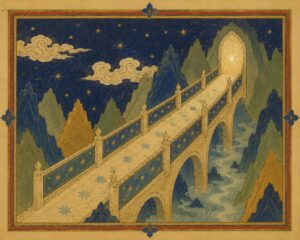
Two people on a bridge. A woman in a Persian cross-coat. A man, watching her go. Everything falling apart around them, and her having to leave him behind anyway.
I didn’t know who they were. I didn’t know what world they lived in or why they were on that bridge or what it had cost them to get there. But the image was so specific and so insistent that I knew it was the thing I’d been looking for.
Farah arrived first, and she arrived fully. That coat, that bridge, that weight. Yasher came after, shaped in part by what the song already knew about him. The devotion in Joey’s verse, the vow to stay, the man trying to be equal to something enormous. The two of them together had the structure of a duet before I understood they were the duet.
The bridge resolved on its own, the way things do when you chase a story hard enough. The Chinvat Bridge, from Zoroastrian belief. The crossing point between worlds. My old History degree surfacing unbidden, crowding out whatever useful thing I’d meant to remember that day. But it was right. It was exactly right.
From there, the world opened up.
Here’s what I didn’t see until I was deep in the second draft. The song already knew things about the book that I hadn’t figured out yet.
Madeleine’s verse has Farah written into it before I knew who Farah was.
Farah hums. It’s her Talent, the way she calls metal and moves it and fights with it. The song has a line about trees waiting to hear what next you’ll hum. I had given her that detail before I understood what I was doing.
“I’m more than what my mum told me to be.” Behnaz raised her. Told her what she was, what she was for. Farah believed it for a long time. The first book is her learning that wasn’t the truth about her.
“To those gods I will speak bluntly. We’ve an accord.” She crosses the Chinvat Bridge alone and stands in front of a god and asks one thing. Is he alive? No preamble. And then she makes the choice, not the House of Song but the fight. That’s the accord.
And the bridge section, where the two voices separate and each one can hear the other but can’t quite reach them. “Where I’m going is for me and me alone.” Nobody crosses that bridge with her. That moment belongs to Farah.
I didn’t plan it. The song just knew.
That’s the thing I keep coming back to when people ask about my process. Music compresses what it takes a novel hundreds of pages to unfold. A three-minute song can hold an entire relationship, an entire impossible choice, in a form that gets into your body before your brain can argue with it. When a song stops me, really stops me, mid-whatever, staring at nothing, something in it knows something I don’t yet. My job is to chase it down and find out what.
There will always be a playlist.
Each book in The Emari Chronicles has one, and they’re not just background or mood boards. They map to characters, to turning points, to the emotional logic of the story. Best played on shuffle, because that’s how the story actually lives in my head. Not linear, but accumulating.
Inkpot Gods is on the Hand playlist. Obviously.
If you end up down a rabbit hole with The Amazing Devil afterward, that’s not an accident. And if you come back from that rabbit hole wanting to know what happened on the Chinvat Bridge, the books are waiting.
The Hand of Mashyana and The Veil of Takhsha are available now. The Emari Chronicles is a four-book Persian-inspired epic fantasy series. Start here.